
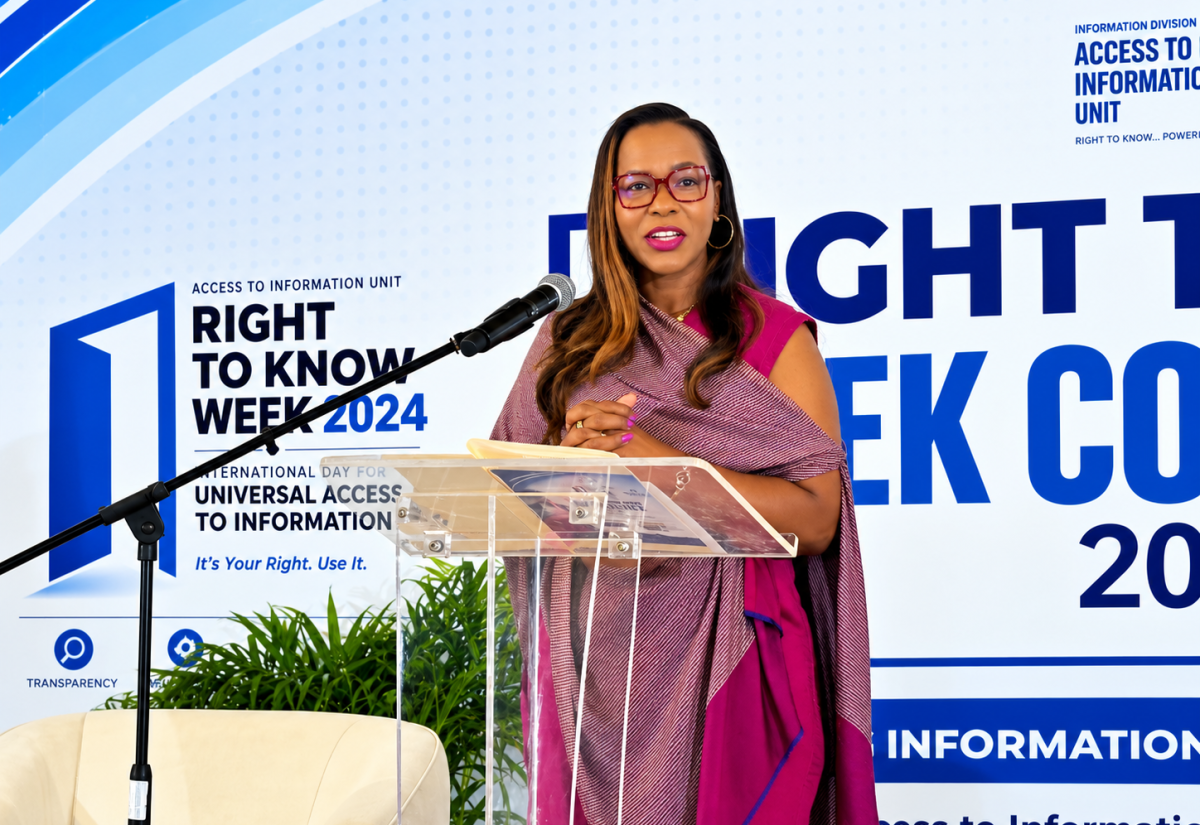
In an effort to make information more easily available to the public, Permanent Secretary, Ministry of Education, Skills, Youth and Information, Dr. Kasan Troupe, is encouraging personnel with jobs relating to information access to be more open, accessible and accountable.
During her address on International Day for Universal Access on Monday (September 28), which is also being celebrated during the Ministry’s Right to Know Conference 2026 at AC Hotel, Kingston, Dr. Troupe made the call.
She encouraged public-sector officers to change their notion of wanting to keep information back and being responsible to the public.
“Colleagues, you are not simply processing requests. You are helping to build a culture; a culture in which citizens know that they can ask questions, a culture in which the public officers understand their responsibilities, a culture in which government information is treated as an important public resource,” Dr. Troupe said.
“It is a part of customer service to have information readily available and to respond. For public officers, I think this requires a shift in how we think about information. The question should not always be, ‘Why should we release this information?’ We should increasingly ask the question, ‘What information can we make available and how can we make it easier for people to find and understand that information?’ That’s the job,” she said.
She noted that access to information can help move public discussion beyond speculation and towards evidence, the foundation to understanding trends, evaluating programmes and generating knowledge.
Dr. Troupe also reminded them that public-sector workers have a responsibility to report publicly, because it is public funds that are paying them. However, she noted that in some legitimate circumstances in which information cannot be disclosed based on law, transparency should not depend entirely on the process.
“For civil society, information supports meaningful engagement with the government and the communities. And for citizens, it can answer something as simple as ‘What is happening and why is this happening?’ Where information can be proactively made available, that should be part of how we approach the public service,” Dr. Troupe said.
“What we do is not private work. It’s public work and we are accountable to the public, and so we have to make sure information is at our fingertips so we can make sure the public is fully aware of what is happening on their behalf… . There is value in all of this, because better informed citizens can engage more meaningfully,” she said.
At the event, there was a wide array of public-sector interests, primarily persons who are a part of departments that are responsible for information sharing and informing the public.
There were public officers responsible for facilitating public access to information, researchers who need reliable information to better understand Jamaica’s society, and civil society organisers who use information to engage the Government and advocate for change.
“Those may appear to be very different interests, yet there is something that connects us all. Information matters and the right to know matters, because people cannot meaningfully participate in society if they cannot access information. They need to understand what is happening around them. They need to have access, and so this is important for any country to be driving this portfolio,” she said.