

Latest News

Ministry intensifies measures to improve CSEC Maths passes

JIS: The Ministry of Education, Youth and Information has redoubled its efforts to improve passes in mathematics at the Caribbean Secondary Education Certificate (CSEC) level.


Portfolio minister, Senator Ruel Reid, informed that the number of maths coaches deployed to the school system has increased from 40 to 70.


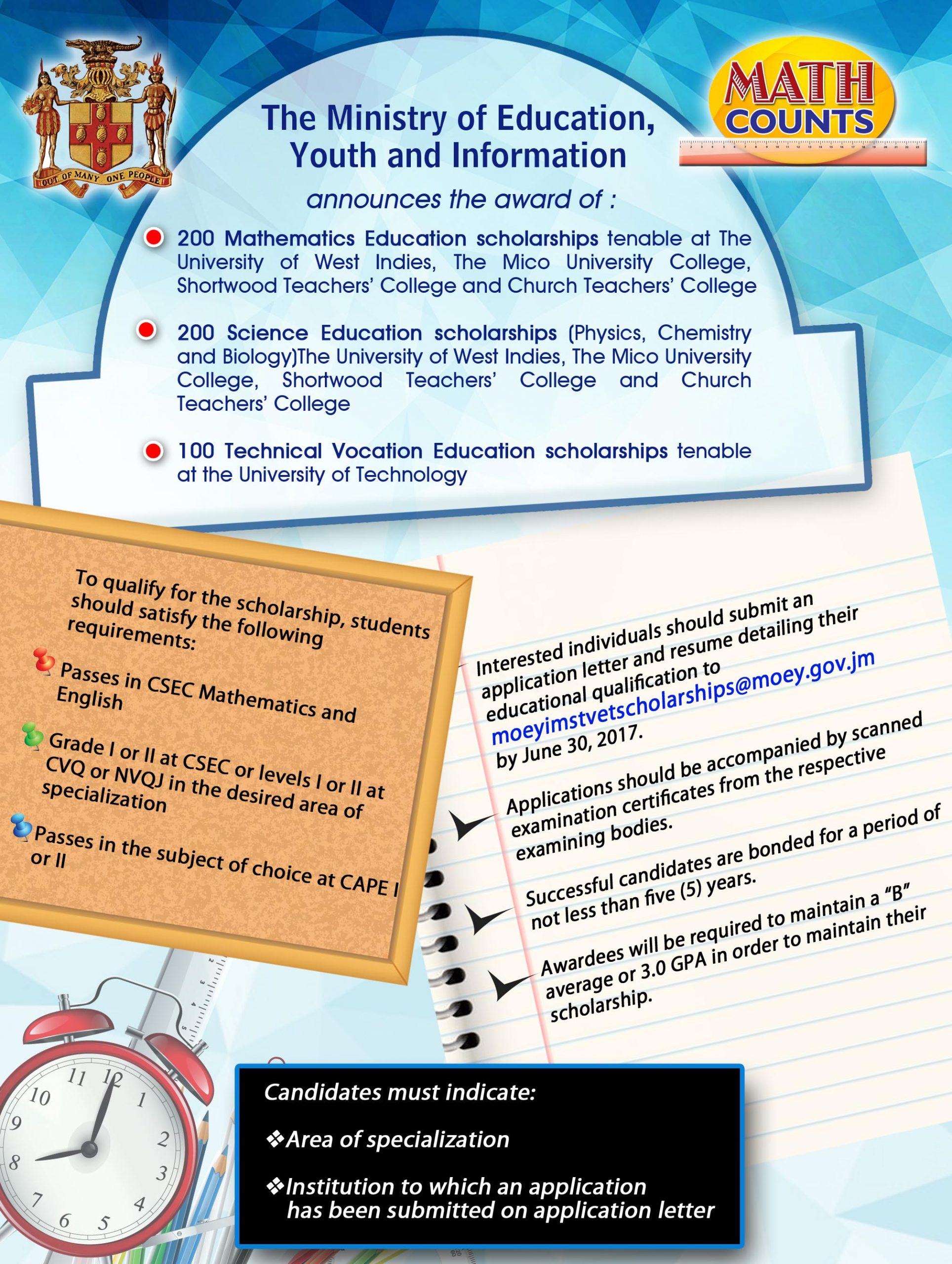
“The ministry has also awarded 168 scholarships to student teachers pursuing courses in secondary-maths education. This is in addition to the 30 students awarded in 2015,” he said. He noted that 200 scholarships are available for the 2017/18 academic year. 


“The goal of this initiative is to increase the number of fully qualified mathematics teachers available for deployment to the education system,” he pointed out.


Other measures include increased student support through camps, and the deployment of tutors to serve approximately 4,000 students in 118 secondary schools. 


“We trained an additional 150 new principals and heads of departments (mathematics) in the leadership of mathematics programme developed and implemented as a partnership between the National Mathematics Programme and National College for Educational Leadership (NCEL),” Reid noted further.


He was speaking at the launch of National Mathematics Week and presentation of the Mathematics Teacher of the Year award at the Mona Visitors’ Lodge, University of the West Indies (UWI) on today.


The ministry is observing National Mathematics Week from March 5-10


Activities got under way with a church service held at the Boulevard Baptist Church in Kingston.  


For the first time, road shows will be held at Holy Trinity High School in Kingston, BB Coke High in St Elizabeth and Hopewell High School in Hanover on March 7.  


The main activity of the week will be the fifth staging of a Mathematics Exposition on the UWI’s Mona Campus on Thursday, March 9. 


This flagship event has grown significantly, with more than 8,000 persons attending last year’s event, up from 2,000 when it was first held in 2013. Some 45 booth holders will be on hand to interact with the participants.  


CAPTION: Minister of Education, Youth and Information, Senator Ruel Reid, addresses the launch of National Mathematics Week and the presentation of the Mathematics Teacher of the Year award at the Mona Visitors’ Lodge and Conference Centre on March 6, 2017. 

Crescent Primary Educator is Mathematics Teacher of the Year

JIS: Neisha Grant Lawrence, teacher at the Crescent Primary School in St. Catherine is the Mathematics Teacher of the Year.


She was presented with her award by Minister of Education, Youth and Information, Senator the Hon. Ruel Reid, during the launch of Mathematics Week at the University of the West Indies (UWI), Mona Visitors’ Lodge on March 6.


Her prizes include a one-year membership to the National Council of Teachers of Mathematics (NCTM), which is the world’s largest organisation concerned with mathematics education, as well as a trip to San Antonio for the NCTM 2017 Conference. She also received an Apple iPad.


Mrs. Grant Lawrence said she was grateful to God, humbled and filled with joy to be the recipient of the coveted award.


“I would like to register my gratitude to the Ministry of Education, more specifically the National Mathematics Team, for implementing such a competition, giving me this great opportunity to demonstrate my mathematics skills outside the walls of my school,” she said.


She said her journey started when the Ministry implemented a programme for the training of School-based Mathematics Teachers (SBMT) at the primary level to improve the performance of students in the subject.


“My principal thought I was the best person for the task, despite my unwillingness, and like many, I feared mathematics from childhood. My principal, seeing the great potential in me, persisted, and I went ahead teary eyed, still reluctant; but look at me now,” Mrs. Grant Lawrence noted.


“Students at my school are understanding mathematics and are having fun while learning. It is my will to see… mathematics (become) the top-performing subject in both primary and high school.


I know all the participants in this competition and other mathematics teachers will see to that,” she said.


She also expressed appreciation to her students, Principal, Iris Lewis and family members, who, she noted, were a constant source of motivation and encouragement.


Other finalists in the competition were Leesan Salmon of the Aabuthnott Gallimore High School; Tarique Tomlinson, from the Godfrey Stewart High School; AnnMarie Plummer Wright of the Bethabara Primary School; and Rosemarie McFarlane Morris of St. Catherine High School.


The contestants were observed teaching mathematics lessons by members of the regional and national mathematics teams as well as education officers. They were also interviewed by a panel of judges on mathematics teaching and learning.


Participants were also tasked to prepare an action plan that they would share with their principal to treat five of the issues identified in the National Education Inspectorate Report in respect to mathematics. Individuals were scored based on these interactions.


The Mathematics Teacher of the Year Award is in its fourth year and is sponsored by Jamaica National (JN).


Senator Reid extended special thanks to the financial institution for its support of the competition since its inception in 2013.


For his part, Permanent Secretary within the Ministry, Dean-Roy Bernard, congratulated the 2017 Mathematics Teacher of the Year.


“I say thank you for your continued good service to the people of Jamaica,” Mr. Bernard said.


The Ministry is observing March 5 to 10 as National Mathematics Week under the theme ‘Math Counts’.


CAPTION: Minister of Education, Youth and Information, Senator the Hon. Ruel Reid (3rd left), presents the Mathematics Teacher of the Year trophy to teacher of Crescent Primary School in St. Catherine, Neisha Grant Lawrence (3rd right). The presentation was made at the launch of Mathematics Week at the University of the West Indies’ (UWI) Mona Visitors’ Lodge on March 6. Sharing the moment (from left) are National Mathematics Coordinator at the Education Ministry, Dr. Tamika Benjamin; Senior Manager, Learning Development Culture, Jamaica National Group, Dr. Renée Rattray; Vice President, Insurance Association of Jamaica and Chief Executive Officer, National Commercial Bank Insurance Company, Vernon James; and Permanent Secretary in the Ministry, Dean Roy Bernard.

Inmates to Benefit From MOU to be Signed by Security Ministry and JFLL

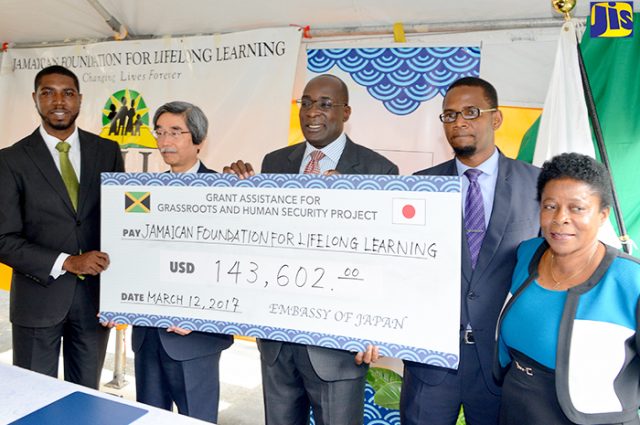
JIS: The Ministry of National Security and the Jamaican Foundation for Lifelong Learning (JFLL) is to sign a Memorandum of Understanding (MOU) to offer educational opportunities to inmates and other interest groups.


In an interview with JIS News, Minister of State in the Ministry, Pearnel Charles Jr., says offering educational programmes to persons in juvenile confinement, prisons or at-risk social groups is a fundamental component to the rehabilitation process and the fight against crime.


He argues that this can have a direct impact on the country’s rate of recidivism and ultimately crime, adding that education behind bars means a greater likelihood of post-release employment, stability and independence for the individual.


“One of the core areas of focus in the ‘Rehabilitation for Reintegration’ agenda is to ensure that all inmates and wards leave our institutions literate and better than when they went in,” the State Minister says.


He notes that the JFLL has had tremendous success in empowering adult learners to become literate through the many programmes they have, and he is confident the inmates will grasp the opportunity.


“Many of our inmates and wards are thirsty to learn and if we intend to abate the cycle of violence, it makes sense to invest in them, hence this MOU,” Mr. Charles says.


“The programme is a practical initiative with clear results. It will help us to see them move from basic literacy to obtaining high school level certification. Many of the inmates have skills but are weak in reading. This project is to help them make the transition to literacy and HEART vocational programmes,” he explains.


The State Minister says one of the primary objectives of the Ministry is to ensure that persons doing time are prepared for success upon release and to help them reintegrate, get jobs, provide for their families and ultimately stay away from crime.


“Correctional education is a cost effective initiative. Every dollar spent on prison education, juvenile centre or at-risk youth groups could save the country millions in fighting crime and prevent re-incarceration,” he tells JIS News.


He notes that it is easier to govern an educated man or woman, because that person should be able to read and understand Government policies and the rationale behind laws.


For his part, Executive Director of JFLL, Worrel Hibbert, said the MOU will be signed with the view of equipping the adult learner with knowledge, skills and the attitude that will make him or her “empowered to achieve their fullest potential.”


He tells JIS News that the JFLL is eager to enter the partnership agreement with the Ministry and the Department of Correctional Services to offer a “second chance” to the youngsters in juvenile detention facilities, individuals who take part in community intervention programmes and inmates housed in correctional facilities across the island.


“We want to pay more attention to the literacy programmes that are available in our prisons and correctional centres,” Mr. Hibbert says.


For her part, Director of Educational Services at the JFLL, Miss Rhoda Crawford, says the agency is very excited about the partnership, adding that the synergy will significantly advance the justice reform programmes.


“I am encouraged by the Ministers’ desire to get things started and the support and commitment from the Ministry to assist us (JFLL) in implementing this life changing opportunity for the inmates and juveniles,” she says.


Miss Crawford notes that the MOU will allow the agency to engage over 4,000 persons from various groups by offering “adult basic (mastery in literacy and numeracy) and adult secondary education (high school equivalency) to those individuals who want a second chance.”


This access, she says, will give them learning opportunities to pursue personal, academic and professional goals.


She adds that from discussions there are plans to start the process of the literacy rehabilitation with the signing of the MOU by the end of this month.


“Once the paper works are done, our first plan of action is to go into the institutions and start by accessing the learners, to see where they are (academically) and then do the placement based on their educational background,” Miss Crawford explains.


She says the proposal is to implement the JFLL’s two-year High School Diploma Equivalency (HSDE) programme in the correctional system, with the hope of giving the inmates secondary level certification.


The HSDE programme, she notes, takes a learner from basic literacy to the proficiency level where they are able to sit Caribbean Secondary Education Certificate (CSEC) subjects.


“We have a track record of being able to move an individual from zero literacy to the attainment of CSEC subjects, so we are confident that this agency (JFLL) can give the impactful results that will change the lives of the people and ultimately impact the crime rate,” Miss Crawford says.


She adds that the proof of such achievement was evident at the agency’s recently held graduation that included several persons who advanced with CSEC subjects after starting the programme at the lowest tier on the literacy scale.


“They were not able to read and write but at the end of the two-year programme we were able to see them graduating with at least five CSEC subjects. This is just what you need to enroll in most colleges and to gain employment, so the HSDE is a ticket to afford all participants an opportunity to reintegrate into the society,” Miss Crawford says.


CAPTION: Minister of State in the Ministry of National Security, Senator the Hon. Pearnel Charles, Jr.


Quality Assurance in Tertiary Education Week from March 6-10

JIS: The University Council of Jamaica (UCJ) will be observing the 12th annual Quality Assurance in Tertiary Education Week from March 6-10 under the theme ‘Enhancing and Sustaining a Quality Culture: Preparing for Institutional Accreditation’.


Executive Director of the UCJ, Althea Heron, said the week will highlight the role of the Council as the national External Quality Assurance Agency for tertiary education.


She said activities will focus on preparing tertiary institutions to deliver quality programmes.


“The UCJ recognises the diversity and creativity of tertiary institutions that operate in Jamaica and the need for a change in basic thinking with regards to quality assurance.


“Therefore, what we are looking at is to help institutions establish their internal quality-assurance systems so they are able to self-regulate and, therefore, work towards ensuring they maintain a robust quality-assurance system that ensures excellence, transparency, integrity and adherence to minimum standards,” she pointed out.


The UCJ will host workshops for assessors and accreditation officers on March 7; and for tertiary institutions at the Jamaica Conference Centre in Kingston on Wednesday, March 8, and the Golf View Hotel in Mandeville on Thursday, March 9.


Vice President of the Commission on Institutions of Higher Education – New England Association of Schools and Colleges (NEASC) in the United States, Dr. Carol Lynn Anderson, will be the facilitator for the workshops.


She has more than 25 years’ experience in enhancing strategic and institutional effectiveness, and her career spans several senior professional roles and includes extensive consultancy work.


In addition to the workshops, the UCJ will publish newspaper supplements in the two major local newspapers on March 6 and 8.


Mrs. Heron said at the end of the week, the participating institutions should have a better understanding of the difference between institutional and programme accreditation.


She added that they should also be able to establish the importance of internal quality assurance in preparing for institutional accreditation as well as improve the quality of the self-study report that is used to evaluate the institution against minimum standards.


CAPTION: Executive Director of the UCJ, Althea Heron

USAID-Funded Skills Training and Employment Programme to Benefit At-Risk Youth

JIS: Jamaica is among three countries in the Latin America and Caribbean region that are benefiting from a Regional Workforce Development Programme (RWDP) aimed at boosting skills training and employment for at-risk youth.


The programme is being implemented over five years through US$35 million in funding from the United States Agency for International Development (USAID).


The objective is to provide the youth with upgraded and market-relevant skills and competencies, in order for them to obtain new or better employment and/or have greater opportunity for career advancement.


Speaking at the launch at the Montego Bay Convention Centre on Thursday (March 2), Region Three Director in the Ministry of Education, Youth and Information, Karlene Segre, said that the intervention is timely and relevant.


Ms. Segre, who represented State Minister, Hon. Floyd Green, welcomed the focus on skills training for at-risk youth, noting that it “fits in very well with the Government’s efforts to get our young people better prepared for the labour market”.


She noted that the Government is proactively seeking to tackle the problem of youth unemployment and skills deficiencies through various initiatives, including the Upskilling and Retooling programme being undertaken by the HEART Trust/NTA and the Joint Committee for Tertiary Education (JCTE).


“We hope that through this progranmme, we will be able to train 3,000 persons annually as skilled. Make no mistake, without a skilled labour force, Jamaica will be left behind as the world sprints forward,” she pointed out.


Education Team Leader at the USAID’s Bureau for Latin America and the Caribbean, Karen Towers, said she is delighted that the programme was being launched in Jamaica.


 She expressed confidence that the beneficiaries will make use of the opportunity to excel.


Ms. Towers noted that the programme has been receiving significant support from students in Guatemala and Honduras, where it is already in operation.


She said USAID programmes have contributed to worldwide efforts to reduce poverty and create opportunities in health, economic growth, environment and governance and democracy


The RWDP aims to strengthen the capacity of two- and three-year technical training institutions in the region to provide market-relevant quality training to youth from disadvantaged populations.


It will improve curriculum design, pedagogy, and professional development for faculty and staff, and enhance labour market bridging services to help students find gainful employment after graduating.


The programme will also strengthen recruiting and admissions practices and provide local and US-based scholarships for disadvantaged students with strong leadership potential.


CAPTION: Region Three Director in the Ministry of Education, Youth and Information, Karlene Segre, addresses the launch of the United States Agency for International Development (USAID)-funded Regional Workforce Development Programme at the Montego Bay Convention Centre, St. James on Thursday, March 2.


More Help for PATH Students

JIS: Students on the Programme of Advancement Through Health and Education (PATH) will benefit from a rental initiative for literature books in the upcoming school year, which begins in September.


Education, Youth and Information Minister, Senator the Hon. Ruel Reid, made the announcement at the end of a two-day international conference on Educational Leadership and Management, at The Knutsford Court Hotel in New Kingston, on March 3.


The conference, which was organised by the Institute of Educational Administration and Leadership, Jamaica, (IEAL-J), was held under the theme ‘Educational Leadership for Sustainability: Current Realities, Future Possibilities’.


In an interview with JIS News, Mr. Reid noted that the rental scheme is geared towards bolstering support to those students on the PATH programme.


“We found that one of the big needs on the book list was literature, because of the significant cost of the books,” he said.


“It is not yet on the rental system. There is no sense in offering rental books for every other subject and not literature, when you may be required to get three books for a year, which would run you $10,000,” the Minister added.


He said emphasis will be placed on PATH students to ensure that “they are really taken care of, as 50 per cent of the student population is on PATH.”


Mr. Reid said that those parents who can support their children in the purchase of literature books should do so.


“I don’t want to provide rental books for persons who can easily purchase them, when you have the very poor who cannot afford it. They are the ones who need to be lifted out of poverty through education,” the Minister said.


Turning to the conference, which focused on educational leadership to ensure inclusive, equitable and quality education for all, Mr. Reid noted that teachers and principals are demonstrating leadership based on a framework of accountability.


This, the Minister said, is evident in so-called failing schools, which have turned around.


Meanwhile, President of the IEAL-J, Professor Paul Miller, said teachers should be given every opportunity to demonstrate leadership.


“Not only does it build their capacity, but it helps with succession planning, and I think it is down to head teachers or principals to create spaces for every teacher in the classroom to demonstrate leadership, to build their capacity and, therefore, to contribute to the development of the school,” he said.


CAPTION: Minister of Education, Youth and Information, Senator the Hon. Ruel Reid (left), listens to Professor the Hon. Errol Morrison, on the final day of a two-day international conference on Educational Leadership and Management, at The Knutsford Court Hotel in New Kingston, on March 3.

Jamaicans Should Support and Promote Positive Messages in Music

JIS: Chairman of the National Youth Service (NYS), Robert Miller, says that Jamaicans should support entertainers who promote positive messages in their music.


Mr. Miller noted that dancehall and reggae music are cultures which impact dress, fashion and body language.


He stated that young impressionable minds, adopt these themes, as part of their daily lifestyle, and are at risk of falling into the kind of lifestyle portrayed by these artiste.


“While this is to a lesser extent, the impact of such music cannot be denied. It is important that Jamaicans support and promote positive messages in the music and to this extent, conscious artistes,” he said.


He was addressing the launch of a mentorship programme for youth in the parish of St. James on February 28, which is being spearheaded by the West Jamaica Conference of Seventh-Day Adventists.


Adding that the influence of the media is profound, the NYS Chairman pleaded for parents to provide guidance on age-appropriate use of all media, including the Internet, television and radio.


He also called for the issue of absentee fathers to be given attention by all sectors of the society, as it adds to youth being unattached, and easily become recruited to criminal networks.


Turning the work of the NYS, the Chairman said the organization is continuing with its mission of developing a strong youth citizenry through programmes aimed at equipping youth 17-24 years with life coping skills.


Mr. Miller said the agency’s programmes have helped in the personal and professional development of these youths, while increasing cultural awareness and encouraging community participation.


“We continue to develop the employability and work experience of our participants through our National Summer Programme, and continue to maintain our core principles, through the Volunteer Programme, which focusses on building civic responsibility and integration among youth,” he told his audience.


Mr. Miller added that several other programmes implemented by the NYS are helping youth to gain skills and certification, and underscored that young people need adults to listen to their concerns, and channel them in positive directions.


CAPTION: Senior Advisor in the Ministry of Education, Youth and Information, Robert Miller. (FILE)

Innovative Workforce the Way Forward

JIS: Jamaica is developing an education system that is quality based, with a special focus on skills in technology, to ensure that the country has a workforce that is creative and innovative.


The Ministry of Education, Youth and Information is also ensuring that students attain strong reasoning skills and the ability to solve problems.


Portfolio Minister, Senator the Hon. Ruel Reid, says one aspect of the reform mandate is the promotion of quality education for the nation’s children to appreciate good governance.


This will be done through the strengthening of the instructional capacities of teachers and the improvement of school facilities, “especially at the primary and secondary levels”, he notes.


The Minister, in his report to a world education forum, in London, England, recently, says as part of the country’s path to growth, the Australian system of education “has provided us with a model to emulate”.


“As such, it is the vision of this Minister, like Australia, to achieve full employment by aligning training to industry,” he argues.


The Minister says the Government is committed to having a world-class education and training system, to produce “well-rounded” individuals who will be able to function creatively and productively in the workforce, and be equipped for local and global industries”.


Citing the importance of Technical and Vocational Education and Training (TVET), in Caribbean economies, as it involves 80 per cent of jobs in the region, Senator Reid says it is an essential area that has the full attention of the Ministry.


“We want to produce a reasonable standard of education that is robust and available for all, with a lifelong-learning context. The goal of this policy is to provide a national framework for the development and sustainability of TVET at all levels in the Jamaican education system,” the Minister explains.


Highlighting the Career Advancement Programme (CAP) of the education system, the Minister says it is geared at improving access to quality education, where no one will be left unaccounted for, and that children between three and 18 years of age are attached to, and attending structured learning and training programmes appropriate to their age.


Phase I of CAP involves a series of diagnostic assessments to determine students’ entry-level capabilities, aptitudes and initial interests in careers.


For Phase II, students who choose technically oriented vocations and have the aptitude for the programmes will pursue TVET courses at levels one and two, in addition to core areas, as well as be provided with opportunities to go further.


Phase III involves in-class education and training for all students in the curriculum. Courses are designed and provided through systematic and organised orientation sessions for teachers, facilitators or counsellors.


Under Phase IV, job placements are offered, as well as job preparation, such as résumé and writing of application letters.


“It should be noted that the job placement/work experience comes at different times during the programme, in order to accommodate the volume of students and ensure that it is applicable to what is being studied,” the Minister says.


Senator Reid emphasises that key to all the objectives being pursued is the development of a National Service Corps, with a vision of providing an avenue for young people to develop themselves through nation building.


It will cater to persons 16-18 who are desirous of continuing education in a school-based environment.


He says the initiative will lead to a knowledgeable and adaptable workforce, with higher levels of general education associated with vocational training.


CAPTION: Minister of Education, Youth and Information, Senator the Hon. Ruel Reid

Early Childhood Commission Looking to Certify 300 Schools by 2019

JIS: The Early Childhood Commission (ECC) is deepening its engagement with existing partners and targeting new ones, as it seeks to certify approximately 300 basic schools by 2019.


One hundred institutions, with an enrolment of approximately 5,000 children, are being targeted under the initial certification phase, which commenced last September and is scheduled for completion in August 2017.


Board Chair, Trisha Williams-Singh, tells JIS News that the ECC has established collaborations with several national and international entities in helping the institutions to meet the ECC’s 12 operational standards.


These relate to staffing; developmental and educational programmes; interactions and relationships with children; physical environment; indoor and outdoor equipment, furnishing and supplies; health; nutrition; safety; children’s rights, protection and equality; interactions with parents and community members; administration; and finance.


“We already have partners like PACE Canada and the Union of Jamaican Alumni Associations (USA) Inc. (UJAA), who we are seeking to re-engage at a different level. We are also working with the National Education Trust (NET); Culture, Health, Arts, Sports and Education (CHASE) Fund; and Jamaica Social Investment Fund (JSIF),” Williams-Singh informs.


PACE (Project for the Advancement of Childhood Education) Canada was founded in 1987 by Jamaican-born educator and Canadian resident, Dr. Mavis Burke, out of a need to assist the island’s early-childhood sector.


The organisation sponsors a number of early-childhood institutions in Jamaica under the theme ‘Helping Kids Excel’.


The UJAA is a New York-based non-profit umbrella organisation of alumni associations of Jamaican educational institutions, founded in 1990.


It was created to assist in unifying the activities of member associations focused on improving educational opportunities for students in Jamaica, and those who have immigrated to the USA.


Mrs. Williams-Singh also cites the pivotal inputs of other entities and organisations, such as the United Nations Children’s Fund (UNICEF); the Sandals and Digicel Foundations; Child Development Agency (CDA); Jamaica Constabulary Force (JCF); Tax Administration Jamaica (TAJ); Jamaica 4-H Clubs; Nutrition Products Limited (NPL); Jamaica Fire Brigade (JFB); and United Way.


She says the ECC is looking to forge additional partnerships at the parish and community levels.


The move, she says, is already yielding positive results, with Director of the One Jamaica Foundation, Ann-Marie Vaz, agreeing to take on the role as the ECC’s point person in Portland, while Journalist, Barbara Ellington, has indicated her interest to work in Manchester.


Their role, she explains “will be to help institutions with capacity-building activities that enable them to attain the ECC’s standards”.


“These persons are volunteering their time because they want to see a better Jamaica. They understand that we have to get it right from the start and that if the foundation is not strong… all else fails. So we invite other well-thinking persons to work with us,” the ECC Chair tells JIS NEWS.


Mrs. Williams-Singh emphasises that the Commission is consistently seeking innovative ways to carry out its mandate.


Among other things, the entity has improved the efficiency of communication with early-childhood practitioners and other stakeholders by introducing modern technology, which has reduced costs, while “providing instantaneous information at their disposal.


Mrs. Williams-Singh says the ECC is also reorganising the staff structure, where necessary, to enable the attainment of “optimum outputs”.


In addition, the entity’s website has been revamped to make it more interactive, thereby facilitating greater inputs from Jamaicans at home and overseas.


She invites persons to visit the site at www.ecc,gov.jm. In addition, she says persons can communicate with the agency on Twitter @eccja and Instagram at earlychildhoodcommission.


Acting Executive Director, Karlene Degrasse-Deslandes, says the entity’s primary objective is ensuring that children’s educational development is administered in a way that enables them to “compete with any child anywhere in the world at any time”.


She tells JIS News that in carrying out its mandate, the ECC is also engaging parents in dialogue to ensure that the home environment is conducive to learning.


There are approximately 2,700 early-childhood institutions in operation across the island.


CAPTION: Early Childhood Commission (ECC) Chair, Trisha Williams-Singh (left), and Acting Executive Director, ECC, Karlene Degrasse-Deslandes, engage in discussion on sector developments.

Early Childhood Commission Looking to Certify 300 Schools by 2019

JIS: The Early Childhood Commission (ECC) is deepening its engagement with existing partners and targeting new ones, as it seeks to certify approximately 300 basic schools by 2019.


One hundred institutions, with an enrolment of approximately 5,000 children, are being targeted under the initial certification phase, which commenced last September and is scheduled for completion in August 2017.


Board Chair, Trisha Williams-Singh, tells JIS News that the ECC has established collaborations with several national and international entities in helping the institutions to meet the ECC’s 12 operational standards.


These relate to staffing; developmental and educational programmes; interactions and relationships with children; physical environment; indoor and outdoor equipment, furnishing and supplies; health; nutrition; safety; children’s rights, protection and equality; interactions with parents and community members; administration; and finance.


“We already have partners like PACE Canada and the Union of Jamaican Alumni Associations (USA) Inc. (UJAA), who we are seeking to re-engage at a different level. We are also working with the National Education Trust (NET); Culture, Health, Arts, Sports and Education (CHASE) Fund; and Jamaica Social Investment Fund (JSIF),” Williams-Singh informs.


PACE (Project for the Advancement of Childhood Education) Canada was founded in 1987 by Jamaican-born educator and Canadian resident, Dr. Mavis Burke, out of a need to assist the island’s early-childhood sector.


The organisation sponsors a number of early-childhood institutions in Jamaica under the theme ‘Helping Kids Excel’.


The UJAA is a New York-based non-profit umbrella organisation of alumni associations of Jamaican educational institutions, founded in 1990.


It was created to assist in unifying the activities of member associations focused on improving educational opportunities for students in Jamaica, and those who have immigrated to the USA.


Mrs. Williams-Singh also cites the pivotal inputs of other entities and organisations, such as the United Nations Children’s Fund (UNICEF); the Sandals and Digicel Foundations; Child Development Agency (CDA); Jamaica Constabulary Force (JCF); Tax Administration Jamaica (TAJ); Jamaica 4-H Clubs; Nutrition Products Limited (NPL); Jamaica Fire Brigade (JFB); and United Way.


She says the ECC is looking to forge additional partnerships at the parish and community levels.


The move, she says, is already yielding positive results, with Director of the One Jamaica Foundation, Ann-Marie Vaz, agreeing to take on the role as the ECC’s point person in Portland, while Journalist, Barbara Ellington, has indicated her interest to work in Manchester.


Their role, she explains “will be to help institutions with capacity-building activities that enable them to attain the ECC’s standards”.


“These persons are volunteering their time because they want to see a better Jamaica. They understand that we have to get it right from the start and that if the foundation is not strong… all else fails. So we invite other well-thinking persons to work with us,” the ECC Chair tells JIS NEWS.


Mrs. Williams-Singh emphasises that the Commission is consistently seeking innovative ways to carry out its mandate.


Among other things, the entity has improved the efficiency of communication with early-childhood practitioners and other stakeholders by introducing modern technology, which has reduced costs, while “providing instantaneous information at their disposal.


Mrs. Williams-Singh says the ECC is also reorganising the staff structure, where necessary, to enable the attainment of “optimum outputs”.


In addition, the entity’s website has been revamped to make it more interactive, thereby facilitating greater inputs from Jamaicans at home and overseas.


She invites persons to visit the site at www.ecc,gov.jm. In addition, she says persons can communicate with the agency on Twitter @eccja and Instagram at earlychildhoodcommission.


Acting Executive Director, Karlene Degrasse-Deslandes, says the entity’s primary objective is ensuring that children’s educational development is administered in a way that enables them to “compete with any child anywhere in the world at any time”.


She tells JIS News that in carrying out its mandate, the ECC is also engaging parents in dialogue to ensure that the home environment is conducive to learning.


There are approximately 2,700 early-childhood institutions in operation across the island.


CAPTION: Early Childhood Commission (ECC) Chair, Trisha Williams-Singh (left), and Acting Executive Director, ECC, Karlene Degrasse-Deslandes, engage in discussion on sector developments.