Latest News

Mineral Heights Primary Taken Off Shift

JIS: The Mineral Heights Primary School in Clarendon is the latest institution to be taken off the shift system by the Ministry of Education, Youth and Information.


This follows the addition of 12 new classrooms under the Jamaica Social Investment Fund (JSIF) Basic Needs Trust Fund (BNTF).


Portfolio Minister, Senator the Hon. Ruel Reid, in his remarks at the official handover ceremony on Thursday (September 13), informed that the nearby May Pen Primary School is next in line to be removed from shift.


He noted that infrastructure is needed to accommodate at least 1,500 students.


“It (May Pen Primary) is one of the largest primary schools in the Caribbean. Already, my technical officers are in the field doing the verification, so that we can plan for that expansion and development,” he informed.


He gave the Government’s commitment to enable the transition of all schools to full day institutions.


“We still have primary and high schools that are on shift… so we have some urgency in which to expand our capacity to ensure everybody has an equal opportunity to attend school at the regular time and get the benefit of a full day programme,” Mr. Reid said.


Mr. Sweeney, in his remarks, said that JSIF is committed to the advancement of education in Jamaica.


“In our 21 years at JSIF, education has been the key aspect of our investment in communities. In excess of 40 per cent of all the funds we’ve received have been invested in education, and that is estimated to be close to $8 billion to date,” he pointed out.


Principal of Mineral Heights Primary, Lanzeford Howell, expressed gratitude for the new classrooms.


“Our students are now able to benefit from a whole-day education that provides them with the enriched activities that children are supposed to benefit from in primary school,” he said.


He noted that teachers can now focus more on enriching the lives of students.


“We are in the era of promoting learning, critical thinking, and this facility that JSIF has contributed to the school will help us in terms of getting our children to function as 21st century learners,” Mr. Howell added.


Funded by the Caribbean Development Bank (CDB), the BNTF makes provision for projects geared towards improvement in education, transportation, enterprise development, water and sanitation services in member countries across the region.


Ten primary schools in seven parishes have benefited from upgrading through the BNTF at a cost of $642,497,824.28. From this investment, five of the 10 schools were able to transition from the shift system to full day school.


In total, 82 new classrooms were constructed or rehabilitated with bathrooms and ramps for disabled students to access. Approximately 10,396 students and 313 teachers have benefited.


The project includes improving the security at the schools through erecting perimeter fencing.


Also at the handover ceremony were Minister without Portfolio in the Office of the Prime Minister and Member of Parliament for Central Clarendon, Hon. Mike Henry; and Minister of State in the Ministry of National Security and Member of Parliament for Clarendon South East, Hon. Rudyard Spencer.


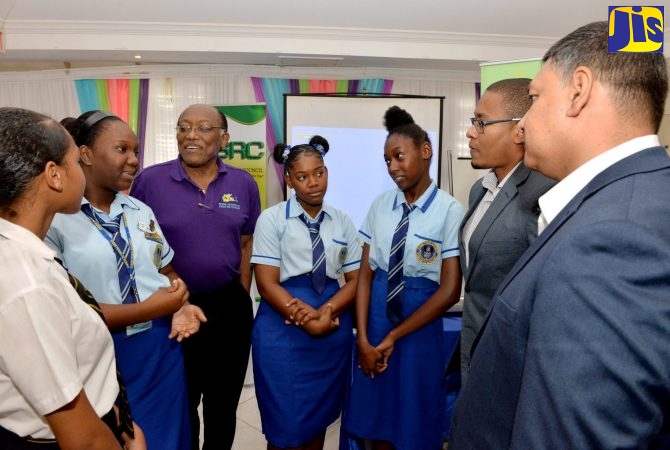
CAPTION: Minister of Education, Youth and Information, Senator the Hon. Ruel Reid (right), enteracts with students at Mineral Heights Primary School in Clarendon after a ceremony on Thursday (September 13) to officially hand over 12 new classrooms. Looking on (from left) are Principal of the school, Lanzeford Howell; and Managing Director, Jamaica Social Investment Fund (JSIF), Omar Sweeney. The new clarooms have facilitated the transition of the school from the shift system.

Education State Minister endorses G20 Declaration on training for employment and sustainable development

MOEYI: State Minister in the Ministry of Education, Youth and Information, the Honourable Floyd Green has endorsed a Declaration on education and training for employment issued at the first-ever G20 Joint Education and Labour and Employment Ministerial Meeting held recently in Mendoza, Argentina.


The G20 noted that technological innovation along with other social, economic and environmental transformations were having a significant impact on global economies and societies as well as changing job requirements and skills demand. As such they reiterated the importance of promoting opportunities for people to acquire new skills throughout their professional and personal lives, so that they can successfully adapt to change. 


The Ministers noted the importance of promoting a holistic, inclusive and lifelong learning approach in skills development policies that respect human rights. Also highlighted was the importance of prioritizing skills development among vulnerable and underrepresented groups, which are at higher risk of exclusion and marginalization. 


Jamaica was invited as a special guest representing CARICOM and in his presentation, Minister Green outlined Jamaica’s curriculum and assessment reforms and new brain builders programme. Ministers highlighted the importance  


21st century skills and provided update on the state of implementation of various skills policies in their respective locale. Minister Floyd Green presented on the World’s Greatest Lesson which showed-case Jamaica’s involvement in teaching the sustainable development goals (SDGs) in schools and committed to ramping up sensitization in this area.


In their Final Declaration the G20 pledged to support the implementation of measures across a range of policies that increase skills development for an inclusive and equitable “Future of Work”, taking into account respective national circumstances. Guidelines for implementation included:

?Promoting the acquisition of strong foundation skills, including numeracy and literacy for all children and youth; and assisting low skilled adults in need of stronger foundation skills.

?Promoting entrepreneurial skills including leadership, initiative taking, sustainability, organizational development and innovation, as entrepreneurship can facilitate job creation, economic growth and social cohesion.

?Fostering STEAM (Science, Technology, Engineering, the Arts and Mathematics) skills in order to emphasize the integration of fields of knowledge with creativity.

?Encouraging the enhancement of digital literacy and digital skills such as programming, big data analysis, coding and robotics in education and work environments as age appropriate.

?Encouraging strategies that apply digital technologies in education and on-the-job-training to upgrade employees’ digital skills taking into account individuals and enterprises’ needs in order to address regional disparities in access to services.

?Promoting Technical and Vocational Education and Training to improve employability and access to quality jobs, combined with active labour market policies and public and private employment services.

?Improving teachers’ and trainers’ competencies and skills through professional development opportunities enabling them to deliver high-quality and up-to-date teaching with technology.

?Supporting schools and training institutions with appropriate infrastructure, administrative capacity and resources necessary to successfully develop 21st century skills among people of all ages.


BACKGROUND

The G20 is an international forum for the governments and central bank governors from Argentina, Australia, Brazil, Canada, China, the European Union, France, Germany, India, Indonesia, Italy, Japan, Mexico, Russia, Saudi Arabia, South Africa, South Korea, Turkey, the United Kingdom, and the United States


More Public Education Needed to Raise Awareness about Mental Health – Reid

JIS: Minister of Education, Youth and Information, Senator the Hon. Ruel Reid, says more public education is needed to raise awareness about mental health issues to offer help and hope to persons suffering from the disorder.


“We need to significantly increase public and private sensitization to the issues of depression and other mental health challenges in workplaces, schools, churches, prisons, public and private sector organizations and indeed all public and private spaces,” the Minister said.


He was delivering the keynote address at the Choose Life International (CLI) World Suicide Prevention Day (WSPD) Seminar, held on September 14 at the Jamaica Conference Centre, in Kingston.


The seminar was held under the theme: ‘Working Together to Prevent Suicide’.


The Minister commended the non-governmental organization (NGO), CLI, for organizing the seminar, which sought to train individuals how to detect signs and how to provide support to individuals suffering from suicidal thoughts.


“I thank Dr. Donovan Thomas, President and Founder of CLI, for the admirable work which he and his hard-working team continue to do. While many are content to sit, talk or just look, CLI has been doing. They have been helping to restore hope to many Jamaicans, who for one or several reasons, are overwhelmed by the heaviness, urgent and never-ending demands of modern life,” he said.


Meanwhile, Dr. Thomas told JIS News that the seminar was staged for all well- thinking Jamaicans with a passion for helping this vulnerable group.


“We have brought together students, police officers, guidance counsellors, pastors, youth leaders and medical doctors willing to help grapple with the issue of how to help people at risk for suicide,” he said.


The seminar featured presentations by Clinical Director of the Medical Services Branch of the Jamaica Constabulary Force (JCF), Dr. George Leveridge;                           


Director of Child and Adolescent Mental Health in the Ministry of Health, Dr. Judith Leiba-Thomas, and Consultant Psychiatrist at the Kingston Public Hospital (KPH), Dr. Terrence Bernard.


Topics covered included: ‘Understanding the Suicide Mind’; ‘Teens, Schools and Suicide: When Educational Goals Collide with Hopelessness’; ‘The Impact of Social Media on Suicidality’, and ‘Working Together to Prevent Suicide’.


World Suicide Prevention Day is organised by the International Association for Suicide Prevention (IASP), to raise awareness around the globe that suicide can be prevented. It is co-sponsored by the World Health Organization (WHO).


CAPTION: Minister of Education, Youth and Information, Senator the Hon. Ruel Reid (centre), listens to Minister of Health, Dr. the Hon. Christopher Tufton (left), at the Choose Life International (CLI) World Suicide Prevention Day (WSPD) Seminar, held on Friday (September 14), at the Jamaica Conference Centre in Kingston. At left is President and Founder of CLI, Dr. Donovan Thomas.

Education Minister Highlights Importance of TVET

JIS: Minister of Education, Youth and Information, Senator the Hon. Ruel Reid, says technical and vocational education and training (TVET) is the most practical avenue for acquiring readily employable skills for the world of work.


Addressing the fifth staging of the National TVET Quality Awards for Secondary Schools at the Jamaica Pegasus Hotel, in New Kingston, on September 14, Senator Reid said Jamaica and the wider world need skilled and competent workers to fill skill gaps in various sectors.


Some of the sectors include: building and construction, power and energy plants, water distribution and sanitation systems, hospitality and agro-processing.


“In addition, we need highly-skilled technical personnel to drive the agenda of transforming our economy through value-addition to primary commodities, and natural resources,” the Minister said.


Senator Reid argued that a well developed and functioning TVET system is best placed to train the skilled workforce which Jamaica needs to address its socio-economic development challenges.


To this end, he said the Ministry will continually strive to improve the relevance and quality of training, integrate ICT into TVET, and ensure flexibility of training and life-long learning in TVET provision.


The Minister lauded the work and contribution of teachers and students in the technical and vocational areas.


Senator Reid said the Ministry’s policy will continue to encourage the alignment of skills development and training delivery with industry priorities.


“We are on the cusp of great things happening in the TVET sector. The awards you are receiving today should encourage and inspire you to aim higher. There is so much more that you can do,” he told the awardees.


The National TVET Quality Awards initiative was implemented to promote technical and vocational education at the secondary level.


It is specially aimed at encouraging creativity and highlighting achievements among teachers and students.


The top awards went to Steer Town Academy for the TVET Project of the Year; Lewisville High for the Best Kept TVET Laboratory; Holmwood Technical High, Innovation in Science Award; Tarrant High School, STEM Challenge Award, while Dennae Mills copped the Best TVET Student award, and Karla Boswell Lewis received the Best TVET Teacher award.


Associate Teaching Fellow at the Mona School of Business and Management and former Executive Director, HEART Trust/NTA, Robert Gregory received the TVET Pioneer Award.


CAPTION: Minister of Education, Youth and Information, Senator the Hon. Ruel Reid, speaks at the national technical and vocational education and training (TVET) Quality Awards ceremony for Secondary Schools, held at the Jamaica Pegasus Hotel in New Kingston on September 14.

Education Management Information System Being Developed

JIS: Minister of Education, Youth and Information, Senator the Hon. Ruel Reid, says an Education Management Information System (EMIS) is being developed that will provide a more detailed, data-driven profile of students.


He said that the EMIS will be supported by information from the National Student Registration System (NSRS) implemented in 2010 to capture biographical and other data on all students entering grade one.


Minister Reid said that with the EMIS, “you will now have an information management system and biodata on students, which will also dovetail into the Child Health and Development Passport, because what we really need is to know very early, the status of the students”.


“The same way you have immunisation data to know how healthy the child is, you also want to know how ready they are for the education system and if they have special needs,” he added.


Minister Reid was speaking with JIS News at a Regional Data Security Conference held on September 13 at the Jamaica Conference Centre, downtown Kingston.


He explained that EMIS will provide a complete profile of the child as soon as they enter the education system.


“For example, do they need special support? Information like that will enable us to track them, intervene and give special support where necessary, so a child that has physical disability, the data will tell you about that child and inform of which school to place them,” he told JIS News.


“We are going to collect more detailed information, so that the system develops a profile of the student, not just to say that you are registered but enable better planning and management within the system,” he added.


Held under the theme ‘Your Data Your Rights; What Individuals and Companies Should Know’, the Regional Data Security Conference was organised by the American Chamber of Commerce (AMCHAM) Jamaica in association with one of its member companies, e-Biz Pro Train.


CAPTION: Minister of Education, Youth and Information, Senator the Hon. Ruel Reid (left), shares a light moment with Facebook Privacy and Public Policy Manager for Latin America, Paula Vargas, at a Regional Data Security Conference on September 13 at the Jamaica Conference Centre, downtown Kingston.

Give PEP A Chance to Succeed – Education Minister

JIS: Minister of Education, Youth and Information, Senator the Hon. Ruel Reid, is urging all stakeholders to come together to ensure the success of the Primary Exit Profile (PEP).


He said it is important that the new assessment “is given the chance to succeed.”


“This is a new system and there will inevitably be things to iron out. However, together we can address these in a spirit of cooperation and partnership. So while it is (the Ministry’s) responsibility to ensure that implementation of…PEP is successful, as stakeholders, we all must collaborate to achieve the desired outcomes,” he said.


Senator Reid was addressing a sensitisation and consultation session for teachers at the Brown’s Town Community College, St. Ann on Wednesday (September 12).


PEP, which will replace the Grade Six Achievement Test (GSAT) as the national secondary-school entrance test, is intended to provide a better and more complete profile of students’ academic and critical-thinking capabilities at the end of primary-level education.


It comprises a Performance Task, Ability Test and a Curriculum-based Test. The first sitting of the examination will take place in 2019.


Minister Reid said that the Ministry will continue to host teacher sensitisation sessions and workshops across the island in order to ensure a greater degree of comfort with the assessment.


He said that acceptance and support of the changes is important in enhancing the teaching-learning process.


PEP is part of the implementation of the National Standards Curriculum (NSC), which places emphasis on project-based and problem-solving learning, with science, technology, engineering and mathematics/science, technology, engineering, arts and mathematics (STEM/STEAM) integrated at all levels.


“During the past year, the Ministry completed the phased implementation of the NSC, which started in 2016 after two years of piloting,” the Minister informed.


He noted that more than $200 million was provided to schools to execute the new curriculum.


“We have started the distribution of the full curriculum publication to our schools for each teacher. This will be completed by this week,” the Minister indicated.


CAPTION: Education, Youth and Information Minister, Senator the Hon. Ruel Reid.

Safety and Security Unit of Education Ministry Gets Support of US$3 Million

JIS: The Safety and Security Unit of the Ministry of Education, Youth and Information has been boosted with a US$3 million support from the United States Agency for International Development (USAID), under the Ministry/USAID Partnership For Safe School project.


Through the project, the Unit will increase the number of hand held metal detectors to 500, and walk through scanners to 30 for the 2018-2019 school year. Funding has also been provided for perimeter fencing, installation of cameras, capacity building training as well as support to uniformed groups.


Addressing a JIS ‘Think Tank’, today (September 13), Director of the Unit, Assistant Superintendent of Police (ASP), Coleridge Minto, said that through the partnership, more than 300 students from across the island also benefited from a special therapeutic behaviour modification camp, held in July under the theme: ‘Chance, Choice and Change’.


He explained that the Ministry’s prime objective is to implement the necessary measures to transform schools and their immediate surroundings into safe zones through a multi-layered and multi-sectoral approach, utilizing both public and private partnerships, supported by legislation and policies where necessary.


According to ASP Minto, the Ministry’s position in treating safety and security in school should be seen as a holistic approach and not left up to an individual.


“As a consequence, the Ministry has mandated that a Security and Safety Committee be established in each school. This committee comprises both internal and external partners who should develop and implement a security and safety plan,” he said.


The Ministry has completed the procurement, printing and distribution of 6,000 Safety and Security Manuals and have begun distribution to the schools.


The Safe School Policy involves a paradigm shift in the area of student behaviour and discipline. It emphasizes prevention and early intervention strategies in dealing with the social, emotional, and behavioural difficulties experienced by some students.


 CAPTION: Assistant Superintendent of Police, Coleridge Minto, Director of the Safety and Security Unit of the Ministry of Education, Youth and Information, addresses a JIS ‘Think Tank’, today (September 13).

Literacy More than Reading and Writing – Senator Reid

JIS: Minister of Education, Youth and Information, Senator the Hon. Ruel Reid, says literacy is more than reading and writing, noting that it is a tool for social and economic empowerment.


“When citizens are literate, it places the country in a better position to address complex issues,” Senator Reid said, adding that it enables individuals to respond in creative ways to challenges, and the building of their communities.


The Minister’s remarks were delivered by Acting Senior Education Officer, Andrew Francis, at an International Literacy Day celebration at the Pembroke Hall Primary School, St. Andrew on Friday (September 7).


Senator Reid said the Government continues to recognise the value of the United Nations Educational, Scientific and Cultural Organization’s (UNESCO) observance, and places great emphasis on literacy, as “we are fully aware of its impact on the lives of our children.”


He noted that empirical evidence shows a positive correlation between strong literacy skills and the overall health and standard of living of citizens.


The Minister said that over the years the Jamaican society has evolved into one that depends “heavily on highly-skilled citizens, to fill critical positions, and to enable economic advancements.”


Regional Director at the Ministry and guest speaker at the event, Dr. Kasan Troupe, said the day’s activities highlight the importance of a literate society in advancing the education agenda.


“We want you to be creative, to learn, to be collaborative and to communicate,” she told the students.


She said that the Ministry continues to implement measures to improve student outcome, and encouraged them to take advantage of the educational opportunities being provided.


“You have the capacity to excel and be the best,” Dr. Troupe said.


International Literacy Day, observed annually on September 8, provides an opportunity for governments, civil society and stakeholders to highlight improvements in world literacy rates, and reflect on the world’s literacy challenges.


Training For Unattached Youth at Renovated Red Hills Skills Centre

JIS: The Red Hills Skills Training Centre in St. Andrew has been renovated at a cost of $3 million and will now offer unattached youth four skill-based courses through partnership with the HEART Trust/NTA.


The refurbishing was undertaken through the Constituency Development Fund (CDF), which provides members of Parliament with financial resources to execute approved social and economic programmes within their constituencies.


The four courses that will be offered are Electrical Installation, Webpage Design, House Keeping and Customer Engagement Operation (Business Process Outsourcing).


Member of Parliament for St. Andrew West Rural, Juliet Cuthbert-Flynn, in her remarks at the reopening on Thursday (September 6), said the facility will enable young people to receive skills training and certification in order to become employable.


She informed that 150 students in St. Andrew West Rural have benefited from tuition grants to pursue higher education through the CDF.


Acting Senior Manager of Special Projects and Community Training, HEART Trust/NTA, Elizabeth Danvers, informed that Caribbean Secondary Education Certificate (CSEC) classes in mathematics and English language will also be offered at the centre.


Based on assessment, students will be encouraged to do another course for their personal development.


“These courses will be offered through the National Unattached Youth Programme. We are looking [at] and anticipating future partnerships [and] we hope this facility will be fully utilised in the years to come,” Ms. Danvers said.


She indicated that orientation for classes will be held on September 11 at the nearby Red Hills Methodist Church and is appealing for unattached youth to attend and register for courses.


She encouraged residents to  “spread the word to your friends, persons you see sitting on the street [and] not doing anything. Encourage them to be a part of this wonderful facility”.


CAPTION: Member of Parliament, St. Andrew West Rural, Juliet Cuthbert-Flynn (fourth right), is assisted by Director, Constituency Development Fund, Kedesha Campbell (third right); Councillor, Red Hills Division, Rohan Hall (left); and Parish Manager, Social Development Commission, Sandra Goulbourne (second left) in unveiling the new sign for the renovated Red Hills Skills Training Centre, at the official reopning on Thursday (September 6). Also sharing in the moment were Custos Rotulorum for the parish of St. Andrew, Dr. Patricia Dunwell (second right) and President, Community Development Committee, Janice Lewis.

Time-Out Facilities to Help Students with Behavioural Problems

JIS: The Ministry of Education, Youth and Information has established two ‘Time Out’ facilities to assist in the rehabilitation of students who exhibit behavioural problems.


The centres were opened this month at Alpha Boys’ School in Kingston and St. John Boscoe Boys’ Home in Mandeville, Manchester.


Chief Education Officer in the Ministry, Dr. Grace McLean, has said that 12 other similar facilities are to be opened across the island.


She was speaking to leaders and educators of independent and private institutions on the new National Standards Curriculum (NSC) and the Primary Exit Profile (PEP) at a sensitisation session on September 5, held at Jamaica College in Kingston.


“These are facilities that will support the children by providing psychosocial, psychological and psychiatric support that is required to ensure that they can be fully rehabilitated and go back to join their peers. What our time-out facilities/retreat centres do is allow them to go through a process of rehabilitation,” she explained.


The facilities are part of several measures being implemented by the Ministry to treat with the needs of students.


Dr. McLean noted that one of the measures in the rehabilitation process is the Ministry’s ‘K-13’ strategy, which provides opportunities for all students to participate and learn.


The ‘K-13’ strategy seeks to ensure that the education system reaches every child from conception to age 18 to facilitate proper stimulation and engagement.


Additionally, she said the Ministry will be working with schools to involve them in the rehabilitation of these children.


“We are currently working through the process that the teachers and the principals are using, so that the process aligns with the Ministry’s strategy of providing equal opportunity and equity for every single child,” she said.


CAPTION: Chief Education Officer in the Ministry of Education, Youth and Information, Dr. Grace McLean (left), discussing Primary Exit Profile (PEP) documents with Principal of Hosanna Preparatory School, Montego Bay, Doreth Chambers, during a sensitisation session with leaders and educators of independent and private institutions on the new National Standards Curriculum (NSC) and the Primary Exit Profile (PEP), on September 5 at Jamaica College in Kingston.